
Orthodontic treatment has advanced rapidly over the past few decades. Where traditional braces were once the only way to straighten teeth, we now have clear aligners: transparent, removable orthodontic appliances. Both aim to correct the alignment of your teeth and your bite, but they work in different ways.
So which is more effective: clear aligners or traditional braces?
The answer depends on the condition of your teeth, the severity of the malocclusion, and how consistently you follow your treatment plan.
What Are Clear Aligners?
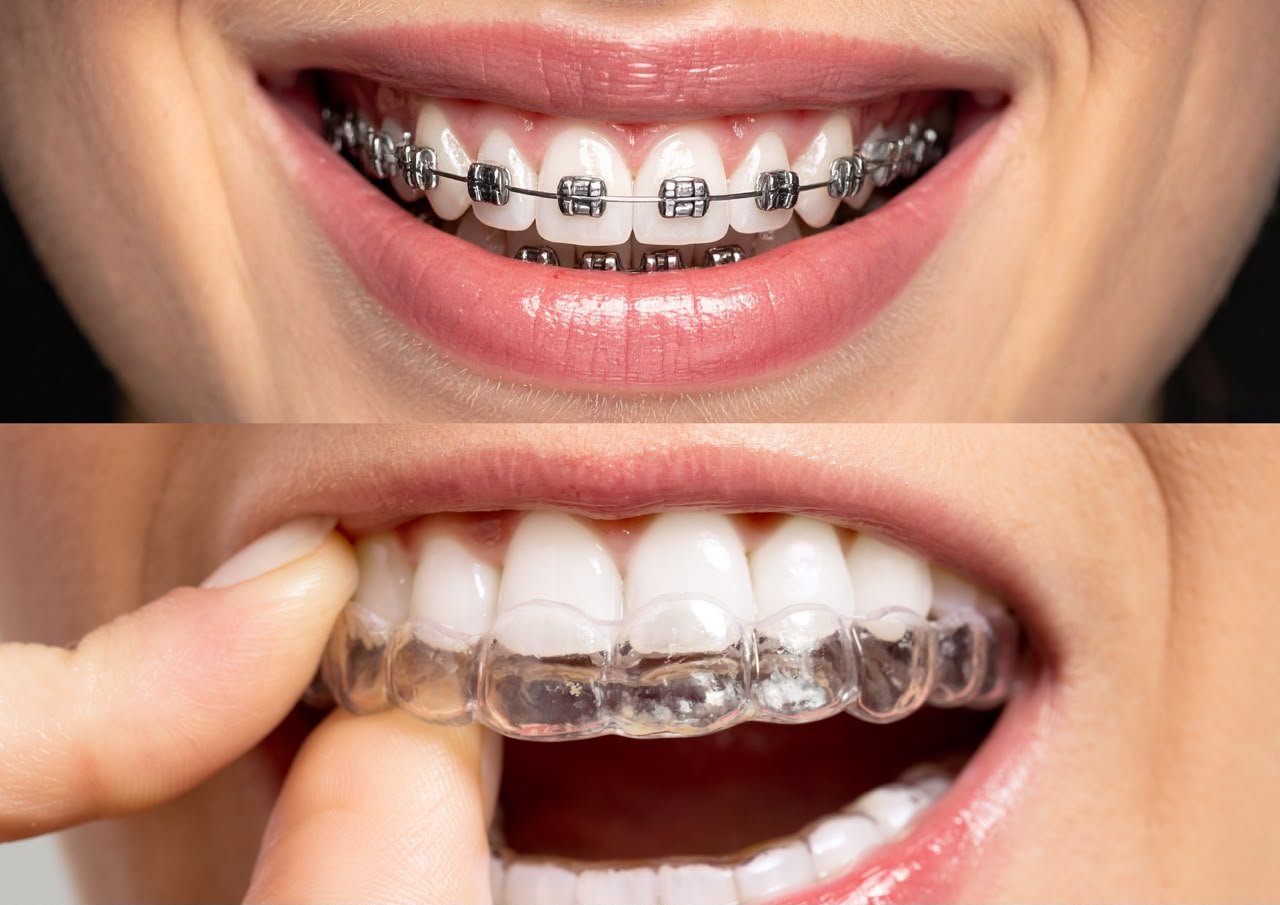
Clear aligners are a series of transparent trays custom-made from a digital scan of your teeth. Each aligner is worn for 1–2 weeks before you move on to the next one, gradually moving your teeth into the desired position.
Because they can be removed for eating and brushing, clear aligners offer better comfort and aesthetics than traditional braces.
What Are Traditional Braces?
Traditional braces use brackets bonded to the surface of your teeth and connected by a wire. Your dentist adjusts the wire at regular intervals to move your teeth until they reach their ideal position.
This method has been used for decades and is still considered the gold standard for complex orthodontic cases.
Which Is More Effective?
Traditional braces still give better control over complex tooth movements, such as severe rotations, significant bite correction, and root movement. Clear aligners, on the other hand, deliver excellent results in mild to moderate cases, especially when worn as directed by your dentist.
In other words, effectiveness is determined not only by the type of appliance, but also by the complexity of the case and the patient’s commitment to the treatment plan.
Advantages of Clear Aligners
Here are some reasons why many patients choose clear aligners:
- A more aesthetic look, since they are transparent.
- They can be removed for eating and brushing.
- It is easier to keep your teeth and gums clean.
- Check-up visits are generally shorter.
- Lower risk of soft tissue irritation compared with metal brackets.
In addition, clear aligner wearers tend to maintain better oral hygiene during treatment than those with traditional braces.
Advantages of Traditional Braces
Traditional braces remain the first choice for many cases because of several strengths:
- They can handle complex orthodontic cases.
- They do not depend on the patient’s discipline in wearing the appliance.
- They provide more precise biomechanical control.
- They are effective for bite correction and root movement.
For patients with severely crowded teeth, overbite, underbite, or severe malocclusion, dentists often recommend traditional braces.
Factors to Consider
Before choosing a treatment, consider the following:
- The severity of the tooth and jaw irregularity.
- Your age and oral health.
- Your lifestyle and aesthetic needs.
- Your ability to keep your teeth clean.
- Your discipline in wearing aligners as instructed.
- The recommendation of your dentist or orthodontist.
Conclusion
Both clear aligners and traditional braces are effective ways to straighten teeth. Clear aligners offer comfort, aesthetics, and easier oral hygiene, making them suitable for mild to moderate cases. Traditional braces, in contrast, remain the best choice for more complex orthodontic cases because they provide better control over tooth movement.
The best choice depends not only on patient preference, but also on the clinical examination and the dentist’s diagnosis. A thorough diagnosis helps determine the most suitable treatment so that the results are optimal, safe, and long-lasting.
Trusted References
- Papageorgiou SN, et al. Efficacy of clear aligner therapy over conventional fixed appliances in controlling orthodontic movement: A systematic review. Journal of Orthodontic Science. 2024.
- Pithon MM, et al. Assessment of the effectiveness of invisible aligners compared with conventional appliance in aesthetic and functional orthodontic treatment: A systematic review. Journal of Investigative and Clinical Dentistry. 2019.